Treating wood for a cutting board is a manufacturing process, not a single finishing step. A well-treated board must remain dimensionally stable, resist cracking and warping, tolerate repeated wet–dry cycles, and maintain a food-safe surface over long-term use. These results depend on how the wood is selected, dried, constructed, finished, and conditioned before it ever reaches the kitchen.
At XINYILIN, wood treatment is built into the entire production workflow. We focus on stability across climates, consistency across batches, and repeatability for bulk order and customized programs. This article explains how wood is properly treated for cutting boards from a manufacturing perspective and how each step affects real-world performance.
For product specifications and construction options, refer to our Wooden Cutting Board: Wooden Cutting Board
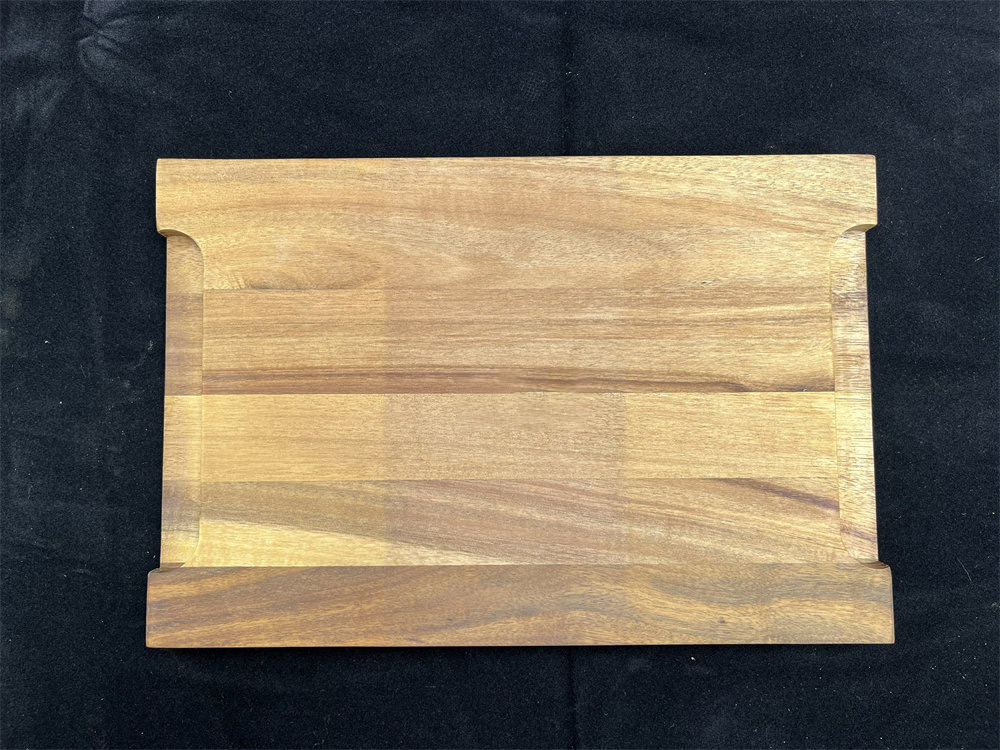
Wood treatment starts with choosing the right raw material. Different species respond very differently to moisture, temperature, and mechanical stress. A cutting board must handle frequent washing and drying without excessive movement, surface checking, or fiber breakdown.
In production, suitable wood selection focuses on:
Stable grain structure with predictable expansion and contraction behavior
Low internal stress and minimal knot concentration
Uniform density to ensure consistent machining and sanding
Long-term supply consistency to maintain appearance across product lines
Beyond species choice, construction style also matters. End-grain, edge-grain, and face-grain boards absorb and release moisture at different rates. Treatment parameters must match the chosen structure to prevent internal stress accumulation during use.
Moisture content is the single most critical variable in cutting board stability. If wood is processed before reaching a controlled moisture range, the board may warp, cup, or crack after shipping, even if it appears perfect at inspection.
A professional drying and stabilization process includes:
Controlled kiln drying to gradually reduce internal moisture
Stress-relief conditioning after drying to equalize moisture gradients
Environmental stabilization before machining to match workshop conditions
Moisture is monitored throughout production, not just at the raw material stage. This prevents late-stage deformation after machining or finishing, when correction is no longer possible.
Moisture control checkpoints
| Production Stage | Control Target | Risk If Ignored |
|---|---|---|
| Raw lumber intake | Screen moisture and defects | Delayed warping |
| Post-kiln drying | Uniform internal moisture | Cracking and cupping |
| Pre-machining | Environmental equilibrium | Twist after cutting |
| Pre-finishing | Dry, stable surface | Uneven oil absorption |
For bulk manufacturing, tight moisture control is essential to achieve consistent thickness, flatness, and edge geometry across large production runs.
Most cutting boards are assembled from multiple pieces rather than a single slab. Construction quality directly affects how the board responds to water exposure and mechanical stress.
Key construction treatment points include:
Precision jointing to minimize glue line gaps
Use of food-safe adhesive systems designed for moisture exposure
Balanced lamination layouts to reduce directional stress
Controlled press pressure and curing time for uniform bond strength
Well-executed bonding prevents water intrusion into joints and reduces the risk of delamination. In customized designs, construction methods also allow visual pattern control without sacrificing structural integrity.
Surface preparation determines how effectively the wood accepts oil or wax treatment. Poor preparation leads to uneven absorption, patchy appearance, and reduced moisture resistance.
Professional surface preparation typically includes:
Progressive sanding to achieve consistent surface smoothness
Edge rounding to reduce chipping and improve handling comfort
Thorough dust removal to prevent particle trapping
Visual and tactile inspection to identify micro-cracks or open grain defects
This stage ensures that treatment oils penetrate evenly and that the final surface feels smooth without becoming slippery.
The purpose of treating a cutting board with oil or wax is to saturate the wood fibers, not to create a surface film. Proper saturation slows moisture exchange, reduces staining, and improves cleanability.
Effective treatment methods include:
Deep mineral oil saturation to penetrate internal fibers
Oil–wax blends to enhance surface feel and moisture resistance
Multiple application cycles with absorption intervals
Controlled wiping and buffing to remove surface residue
Rather than a single heavy application, repeated controlled saturation produces a more stable and durable result. The process continues until the wood’s absorption rate decreases, indicating sufficient fiber filling.
Treatment method comparison
| Treatment Method | Main Benefit | Typical Application |
|---|---|---|
| Mineral oil saturation | Deep penetration and easy reconditioning | Daily-use boards |
| Oil and wax blend | Improved tactile feel and surface protection | Premium product lines |
| Multi-cycle saturation | Enhanced climate stability | International shipping programs |
For bulk orders, the treatment process must be standardized so every board achieves similar absorption depth and surface consistency.
Treatment does not end when oil is applied. Curing and conditioning allow the oil to distribute evenly and stabilize within the wood structure.
Critical post-treatment controls include:
Adequate curing time before packaging to prevent surface transfer
Controlled storage humidity to avoid rapid moisture shifts
Protective packaging to prevent abrasion and edge damage
Final inspection to confirm uniform appearance and dryness
These steps are especially important for export shipments, where boards may experience long transit times and varying climates.
XINYILIN integrates wood treatment into the full manufacturing process rather than treating it as a final cosmetic step. Our focus is on stability, consistency, and repeatability across production batches.
Our approach typically includes:
Controlled drying and moisture stabilization
Precise construction and bonding management
Consistent surface preparation standards
Repeatable food-safe oil and wax treatment protocols
For bulk order and customized programs, treatment parameters can be aligned with target markets, packaging requirements, and end-user maintenance expectations. This ensures that boards perform reliably from factory to final use.
For product specifications and construction options, refer to our wooden cutting board: Wooden Cutting Board
Treating wood for a cutting board is a system-level process that combines material selection, moisture control, structural construction, surface preparation, and controlled food-safe finishing. When these elements are managed together, the result is a cutting board that remains stable, hygienic, and durable throughout its service life.
If you are developing a cutting board program with specific wood species, dimensions, surface feel, or packaging requirements, XINYILIN can support treatment standardization and customized production planning. Share your target specifications and order volume, and we will recommend a suitable manufacturing and treatment solution for your project.