The answer matters more than many buyers expect. A wood cutting board is not cleaned the same way as plastic or stainless steel. If it is soaked too long, left wet, or cleaned with the wrong method, the board may warp, crack, or lose its surface stability over time. That is why proper cleaning is not only a household care topic. For wholesalers, retailers, hospitality buyers, and kitchenware importers, it is also part of product value.
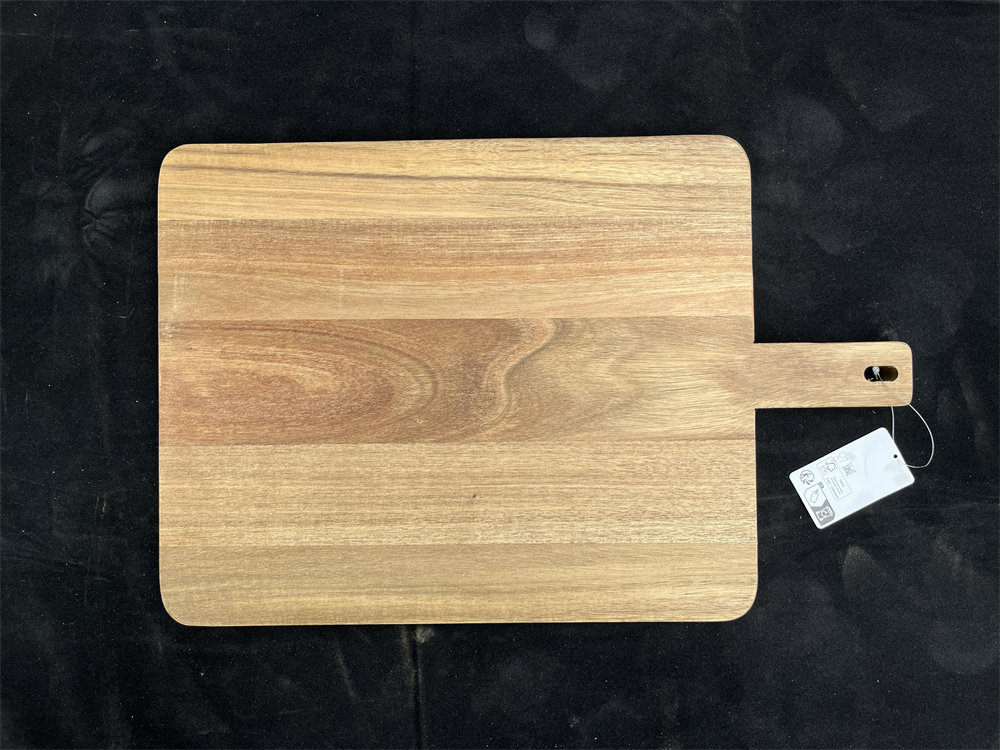
Our rectangle acacia wood cutting board fits naturally into this discussion because it is built as a solid wood board for daily food preparation, restaurant use, and retail supply. It uses a single piece of acacia wood in a 48 × 31 × 2.0 cm format, with either food-grade oil or varnish treatment depending on order needs.
Wood is a natural material, so it reacts differently from synthetic kitchen tools. It can absorb moisture, release it slowly, and respond to humidity changes over time. That is why a wood cutting board should be cleaned thoroughly but not aggressively.
The main goal is to remove food residue, oil, and odor without forcing too much water into the wood. That is especially important for acacia boards, because buyers usually choose them for their natural grain, solid feel, and longer service life. Our product uses dense acacia wood rather than bamboo or multi-layer composite construction, and the single-piece structure helps avoid delamination issues often seen in lower-grade boards.
In normal daily use, the best approach is straightforward. After cutting, the board should be washed by hand with mild soap and warm water, then wiped clean and dried soon after. It should not stay wet on the counter for too long, and it should not be left standing in water.
For stronger smells or food residue, a deeper clean may be needed. What matters most is that the board is cleaned evenly and dried fully. A rushed wash followed by air-drying in a damp corner often causes more trouble than the food itself. In practice, many problems blamed on “bad wood” actually come from poor drying habits after cleaning.
That is one reason professional buyers care about surface treatment. Our board can be finished with edible-grade oil or lacquer, and that choice affects both the natural hand feel and the daily cleaning style. The food-grade oil version keeps a more natural wood touch, while the varnish version is often easier for routine cleaning.
A wood cutting board is not really clean if it stays damp for hours. Moisture left inside the surface can lead to odor retention, a sticky feel, surface movement, or long-term cracking risk. Good cleaning always includes proper drying.
This is especially true in kitchens with heavy use, such as restaurants, food prep rooms, and retail tasting counters. In those spaces, boards are washed more often, so the drying step becomes part of maintenance quality. Our acacia board is designed with a 2.0 cm solid thickness for better rigidity and long-term stability, but even a stable board performs better when it is dried correctly after each wash.
Many buyers choose acacia because it offers a good balance between hardness, natural appearance, and everyday usability. It is dense enough to handle repeated cutting, but still attractive enough for serving and display use. Our product page notes an air-dried density of about 0.75 to 0.85 g/cm³ and describes the surface as more wear-resistant than common pine and bamboo options.
That matters for B2B customers. A board that looks good on the shelf but wears down too quickly is difficult to support in repeat orders. Buyers usually want a product that works in home kitchens, food prep use, and retail display without losing its shape too quickly. Our board is also described for home kitchen work, restaurant food preparation, cold food display, food processing, and retail display, which gives importers and wholesalers a broader sales angle.
For individual users, cleaning is a maintenance habit. For distributors and retailers, it is also part of after-sales communication. If customers do not know how to care for a wood cutting board, they are more likely to report avoidable issues like warping, cracking, or odor retention.
That is why experienced kitchenware buyers often look beyond product photos. They want stable dimensions, reliable finishing, workable packaging, and a product that is easy to explain to end customers. Our board is supplied with standard export packing of poly bag, inner box, and export carton, with an MOQ of 300 sets and a lead time of 30 to 35 days. The page also notes that retail display packaging can be adjusted during the ordering process, which is useful for private label and distribution programs.
A wood cutting board may look simple, but in bulk purchasing, consistency matters. Buyers want the same size, similar finish quality, and controlled visual variation across batches. Natural wood will always have some grain difference, but supply should still remain within a manageable range.
Our product page explains that production uses standardized trimming processes with size tolerance controlled within ±2 mm, and it also notes that acacia color differences are graded within the same batch to keep the overall visual effect more consistent. For B2B customers, that kind of control is often just as important as the material itself.
Cleaning a wood cutting board properly is not complicated, but it does require the right habits. A good clean means gentle washing, no soaking, and full drying afterward. That is what helps protect the board’s surface, reduce odor, and extend usable life.
For buyers sourcing wooden kitchenware in volume, the bigger issue is choosing a board that is easier to maintain and easier to sell. Our rectangle Acacia Wood Cutting Board offers solid single-piece construction, practical size, surface finish options, and stable batch supply for home, retail, and food service channels. If you are planning a cutting board program for wholesale, private label, or commercial kitchenware distribution, feel free to contact us. We can help you review finish options, packaging needs, and order details to find a solution that works well for your market.
Previous: Is Acacia Wood Good for Cutting Boards?