Onion contains strong sulfur-based aroma compounds that can remain on a Wooden Cutting Board after the visible food residue has been removed.
Wood has a natural grain structure that may retain moisture, oil, and odor-producing particles. The smell is often more noticeable when the board is stored before it has dried completely.
A practical cleaning routine should remove food residue, reduce the odor, and dry the board without soaking or damaging the wood.
Scrape loose onion pieces into the waste container.
Wash the board with warm water, mild dishwashing liquid, and a soft sponge. Clean both sides, even when only one side was used, so moisture exposure remains more balanced.
Rinse promptly and wipe the board with a clean towel.
Odor becomes harder to remove when onion juice dries inside knife marks and surface pores.
Cleaning immediately also reduces the chance that the smell transfers to fruit, bread, or other mild foods during the next use.
Mix baking soda with enough water to form a soft paste.
Spread the paste over the cutting surface and leave it for approximately 10 to 15 minutes. Scrub gently with a soft brush or sponge, following the grain direction.
Rinse the board thoroughly and dry it upright.
Baking soda can absorb and neutralize some odor-producing residue.
It should be used as a mild cleaning aid rather than an aggressive abrasive. Heavy scrubbing can leave the cutting surface rough.
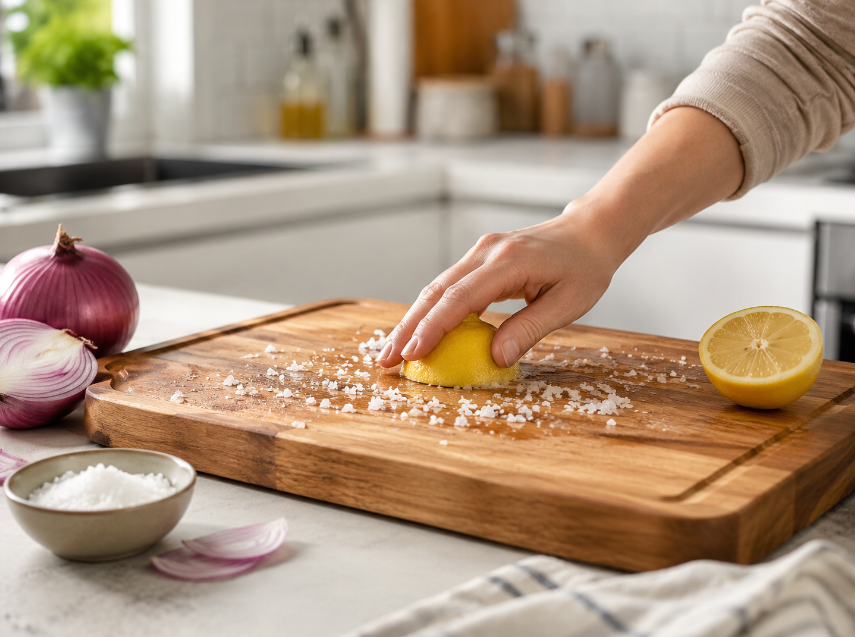
Sprinkle a small amount of coarse salt over the damp board.
Cut a lemon in half and rub the cut side over the salt and wood surface. Work across the full cutting area, paying attention to deeper knife marks.
Leave the mixture briefly, then rinse it away with clean water.
Lemon is acidic and may lighten some wood finishes or create uneven color on decorative serving boards.
Use this method cautiously when the board has a colored coating, lacquer, printed design, or unknown surface treatment.
After washing, place the cutting board upright in a ventilated location.
Air should reach both faces. Do not place the wet board flat on a countertop because moisture trapped underneath can create a musty smell.
Avoid drying it beside a heater or in intense sunlight, which can cause uneven moisture loss and warping.
Do not use methods that create additional damage or leave unsuitable residue on a food-contact surface.
Avoid:
Soaking the board in a sink
Washing it in a dishwasher
Using heavily perfumed detergent
Applying furniture polish
Using non-food-safe wood oil
Scrubbing with steel wool
Storing the board while damp
Mixing several cleaning chemicals
One cutting board can be used for many foods when it is cleaned correctly, but separate boards may simplify kitchen organization.
A household may reserve one board for onions and strong aromatics, another for bread and fruit, and another for raw meat or seafood.
Clear separation can reduce odor transfer and support more controlled food-preparation routines.
Frequent washing may gradually remove the conditioning oil from the wood.
When the board looks dry, pale, or rough, allow it to dry completely and apply food-safe mineral oil or board wax. Coat the edges and reverse side as well as the cutting face.
Remove excess oil before the board returns to food preparation.
A wooden cutting board should be inspected regularly.
Replacement may be appropriate when it has:
Deep cracks
Separated glued joints
Persistent mold
Severe warping
Splintered edges
Deep grooves that are difficult to clean
Odor that remains after repeated cleaning
Light knife marks alone do not always mean the board has reached the end of its useful life.
Dense acacia wood is frequently selected for cutting and serving boards because it provides a distinctive grain pattern and a stable working surface.
However, every natural wood product can respond to moisture and temperature changes. Board thickness, grain direction, moisture control, sanding quality, finish application, packaging, and storage all influence the finished product.
As a wooden cutting board Manufacturer, we provide OEM and ODM support for standard and customized kitchenware.
Our production range includes rectangular, oval, fish-shaped, trapezoid, paddle-style, handled, grooved, and extra-large acacia wood boards.
We can coordinate product development, dimensions, finishing, engraving, inspection, packaging, and delivery for international buyers.
Sourcing boards for food brands, retailers, restaurants, gift stores, or hospitality projects?
Send us your design, dimensions, wood type, finish, logo position, packaging requirement, and expected volume. Our team will prepare a customized proposal from an experienced Wooden Cutting Board Manufacturer.
Previous: How To Paint Pressure Treated Wood?