Wooden bowls can be suitable for everyday dining when they are manufactured for food contact, finished with appropriate materials, and maintained correctly. Their natural appearance makes them popular for serving salads, fruit, rice, pasta, bread, and other meals.
However, not every decorative wooden container is designed for food. The wood species, surface finish, construction, cleaning method, and condition of the bowl all influence whether it remains suitable for regular use.
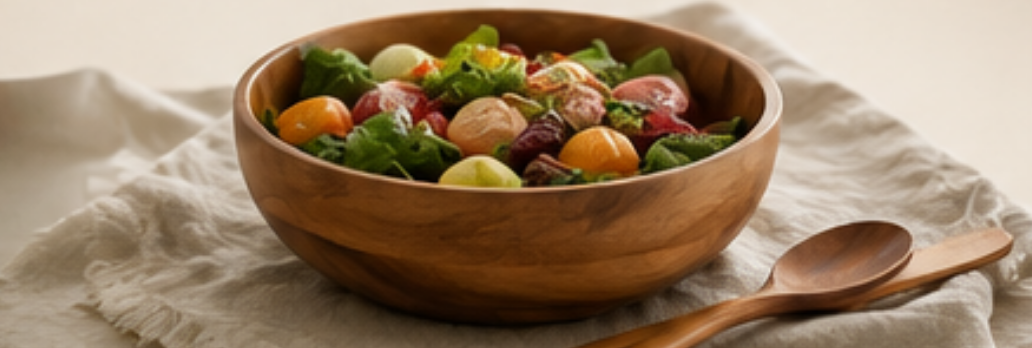
A bowl intended for food should have a smooth surface without loose fibers, deep cracks, mold, or peeling coatings.
Important factors include:
Suitable wood species
Controlled moisture content
Smooth sanding
Food-contact surface treatment
Stable bowl construction
Clear cleaning instructions
No unknown paint or decorative coating
A bowl made only for storing keys, candles, or ornaments should not automatically be used for meals.
Wooden bowls may use a penetrating oil, wax treatment, or cured coating designed for food-contact applications.
The finish helps limit rapid moisture absorption and makes routine cleaning easier. It should remain smooth and firmly attached to the wood.
Stop using the bowl for food if the coating becomes sticky, flakes away, develops bubbles, or exposes rough fibers beneath the surface.
Wooden bowls are particularly practical for foods that are served for a limited period and do not require prolonged soaking.
Common applications include:
Salads
Rice
Pasta
Fruit
Nuts
Bread
Breakfast cereals
Dry snacks
Side dishes
Room-temperature meals
The warm color and natural grain also make wooden bowls suitable for restaurant presentation, home dining, gift collections, and hospitality tableware.
A wooden bowl may hold warm food when the product is designed for that application.
Before serving soup or another hot dish, confirm that:
The finish is suitable for warm food
The bowl has no cracks
The surface is not peeling
The product does not leak
The food will not remain inside for a long period
Wooden bowls should not be placed over a direct flame or used as cooking pots.
Very high heat may dry the wood unevenly, damage the surface treatment, or cause deformation.
Tomato sauce, citrus fruit, vinegar-based dressing, berries, and strongly colored food can stain some wooden surfaces.
The result depends on the wood and finish. A properly sealed bowl may resist ordinary contact, while an untreated or worn surface may absorb color and odor more easily.
For commercial dining projects, sample testing with the intended menu is useful before confirming a large order.
Wooden bowls should normally be washed by hand.
Use warm water, mild dish soap, and a soft sponge or cloth. Rinse away the detergent and dry the bowl immediately with a clean towel.
After towel drying, place it in a ventilated area until the remaining moisture has evaporated.
Leaving a wooden bowl in a sink for a long period allows water to enter the grain.
Repeated soaking may lead to:
Warping
Cracking
Swelling
Raised grain
Joint separation
Finish damage
Persistent odor
Cleaning the bowl soon after use is better than allowing food residue to dry on the surface.
Dishwashers expose tableware to high temperatures, strong detergents, prolonged moisture, and heated drying.
These conditions may cause wood to expand and contract rapidly. Unless the manufacturer specifically approves dishwasher use, hand washing is the safer method.
Some natural or oil-finished bowls benefit from occasional maintenance with an approved food-contact oil.
The bowl may need care when the surface becomes dry, pale, rough, or absorbs water more quickly than before.
Do not apply ordinary cooking oils without checking their suitability. Certain oils can become rancid and leave an unpleasant smell.
Follow the supplier’s care instructions for the specific surface treatment.
Remove a wooden bowl from food service when it develops damage that can trap moisture or food residue.
Replacement is recommended when there are:
Deep cracks
Mold spots
Loose splinters
Peeling finish
Open glued joints
Soft or decayed wood
Strong retained odor
Severe deformation
Natural changes in color are not always a problem. Structural damage and surfaces that can no longer be cleaned are more important concerns.
Restaurants, hotels, retailers, and tableware distributors should review the full specification before purchasing.
| Specification | Purchasing Consideration |
|---|---|
| Wood species | Influences grain, color, hardness, and price |
| Bowl dimensions | Determines serving capacity |
| Surface finish | Must match food use and cleaning |
| Construction | Solid or laminated structure |
| Rim thickness | Influences handling and durability |
| Internal surface | Should remain smooth and accessible |
| Care instructions | Needed for users and service staff |
| Packaging | Must protect the rim and finish |
A sample should be reviewed with the intended food and cleaning process before mass production.
Our factory has produced wooden kitchenware since 2007. Our product categories include Wooden Cutting Boards, pizza boards, utensils, pepper mills, rolling pins, coffee accessories, trays, and customized wooden products.
For Food Safe Wooden Bowls, buyers can provide drawings, physical samples, dimensions, preferred wood, finish requirements, logo methods, and packaging references.
We support OEM and ODM development from sample confirmation through production and delivery.
Send us the required diameter, depth, wood species, intended food application, finish, logo, packaging, destination market, and purchasing quantity.
Our team will review the details and prepare a Food Safe Wooden Bowls proposal for sample evaluation.