The best wood for tableware depends on the product being manufactured. A spoon requires a smooth grain and sufficient strength along the handle. A plate needs dimensional stability, while a serving tray must support weight without becoming excessively heavy.
Acacia, beech, maple, walnut, teak, and bamboo are commonly considered for wooden kitchenware, but they offer different appearances, costs, machining characteristics, and maintenance requirements.
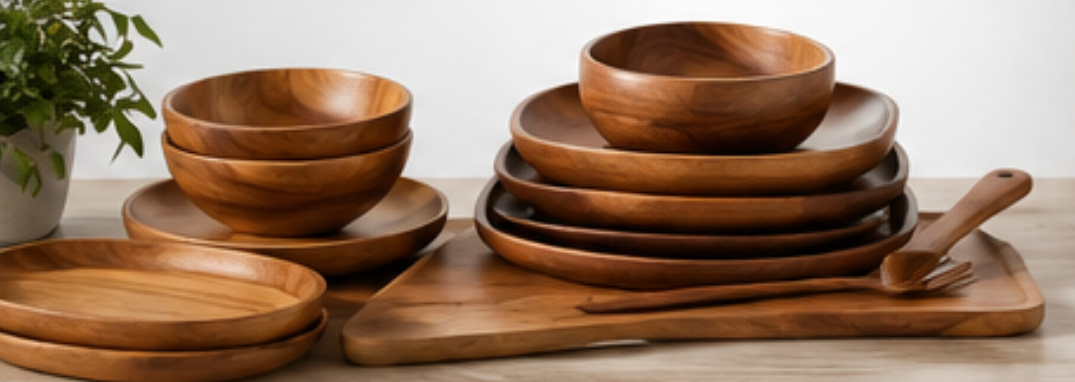
Wood for tableware should be selected according to both appearance and performance.
Important factors include:
Hardness
Grain structure
Moisture response
Weight
Machining performance
Surface smoothness
Raw-material stability
Finish compatibility
Color variation
Target price
A beautiful wood can still perform poorly when it is not dried, shaped, sanded, and finished correctly.
| Wood | Typical Appearance | Main Advantage | Main Consideration |
|---|---|---|---|
| Acacia | Warm brown with varied grain | Distinctive appearance and good hardness | Natural color differences |
| Beech | Pale color and fine grain | Smooth machining and practical for utensils | Requires controlled drying |
| Maple | Light color and subtle grain | Hard and suitable for minimal designs | Stains may be visible |
| Walnut | Dark brown and elegant | Premium appearance | Higher material cost |
| Teak | Golden brown with natural oils | Good moisture resistance | Cost and finishing requirements |
| Bamboo | Light laminated appearance | Lightweight and fast-growing | Usually made from laminated sections |
The final choice should reflect the intended product rather than one general ranking.
Acacia is widely used for tableware because it combines strong visual grain with useful hardness.
It can be developed into:
Bowls
Plates
Serving trays
Pizza boards
Salad utensils
Table caddies
Bread trays
Decorative serving pieces
The wood’s warm brown appearance suits both natural interiors and modern retail collections.
Acacia may contain light, medium, and dark sections within one product.
This variation is part of the material rather than necessarily a production defect. Buyers should approve a color range instead of expecting every piece to match one small sample exactly.
When a more uniform appearance is required, material sorting and finish selection should be discussed before production.
Beech has a lighter color and a relatively fine, even grain.
It is frequently used for:
Spatulas
Rolling pins
Utensil handles
Small bowls
Kitchen tools
Children’s tableware
Its smooth appearance works well with simple forms and natural finishes.
Beech can also be suitable when the product needs painting or color finishing, although the selected coating must match the intended application.
Maple is often selected for modern tableware with a clean, pale appearance.
Its subtle grain can support Scandinavian, minimalist, and contemporary product collections.
Maple may be suitable for:
Plates
Bowls
Serving boards
Trays
Utensils
Gift tableware
Because the color is light, food stains and marks may be more visible. Surface treatment and cleaning instructions should therefore be considered carefully.
Walnut provides a naturally dark brown appearance that can create a premium effect without heavy staining.
It is often used for:
Gift sets
Hotel serving products
Coffee accessories
Decorative trays
Premium cutting boards
High-end retail tableware
Walnut may increase the unit cost, so it is usually selected for product ranges where material appearance supports a higher market position.
Teak contains natural oils and is known for its resistance to moisture.
However, it is not automatically the most practical choice for every tableware product.
Its oil content may influence gluing and surface finishing. Buyers also need to consider raw-material sourcing, cost, color variation, and availability.
For tableware that receives only normal short-term food contact, acacia or beech may offer a more balanced combination of appearance, production efficiency, and price.
Bamboo is technically a grass rather than a tree, but it is widely used in the wooden tableware market.
Bamboo products are normally made by bonding processed strips or sections together.
It can provide:
Light weight
Uniform appearance
Efficient material use
Practical strength
Competitive pricing
The adhesive, lamination structure, edge finishing, and surface coating are important parts of the product specification.
Solid wood shows natural grain and can create a premium appearance.
Its size is limited by available raw material, and wider products may experience more natural movement as humidity changes.
Laminated products combine several wooden sections.
This structure can support larger dimensions, improve material use, and create decorative grain patterns.
The adhesive and construction must be appropriate for the intended tableware use and cleaning method.
Grain direction affects strength and machining.
For Wooden Utensils, the grain should generally follow the length of the handle. Cross-grain sections may be more vulnerable to breakage.
For plates, bowls, and trays, manufacturers must consider:
Grain orientation
Wall thickness
Rim structure
Internal curves
Drying conditions
Sanding direction
Finish absorption
Wood selection cannot be separated from product design.
The best wood species can still produce an unsuitable product if the surface treatment is incorrect.
A tableware finish should support:
Direct food contact
Normal hand washing
Smooth touch
Resistance to common food stains
Controlled moisture absorption
Routine maintenance
Penetrating oils and cured coatings require different care methods, so clear instructions should accompany the finished product.
One collection may use several wood species according to product function.
A coordinated range could use:
Acacia for bowls, boards, and trays
Beech for spoons and rolling pins
Walnut for premium gift items
Maple for pale plates
Bamboo for selected laminated accessories
Consistent logo placement, packaging, and finish tone can keep the range visually connected.
Our product range includes acacia cutting boards, uniquely shaped boards, acacia utensils, beech utensils, rolling pins, wooden spoons, coffee accessories, trays, and table caddies.
We provide OEM and ODM support from design and sample development through production and shipment.
Buyers may submit a drawing or physical sample for technical review. Custom options include product dimensions, wood selection, surface finish, engraving, branding, and packaging.
Send us the target product categories, dimensions, wood preference, finish, color standard, logo, packaging, and purchasing plan.
We will prepare an Acacia Wood Tableware proposal and recommend alternative materials when another wood is better suited to a particular product.